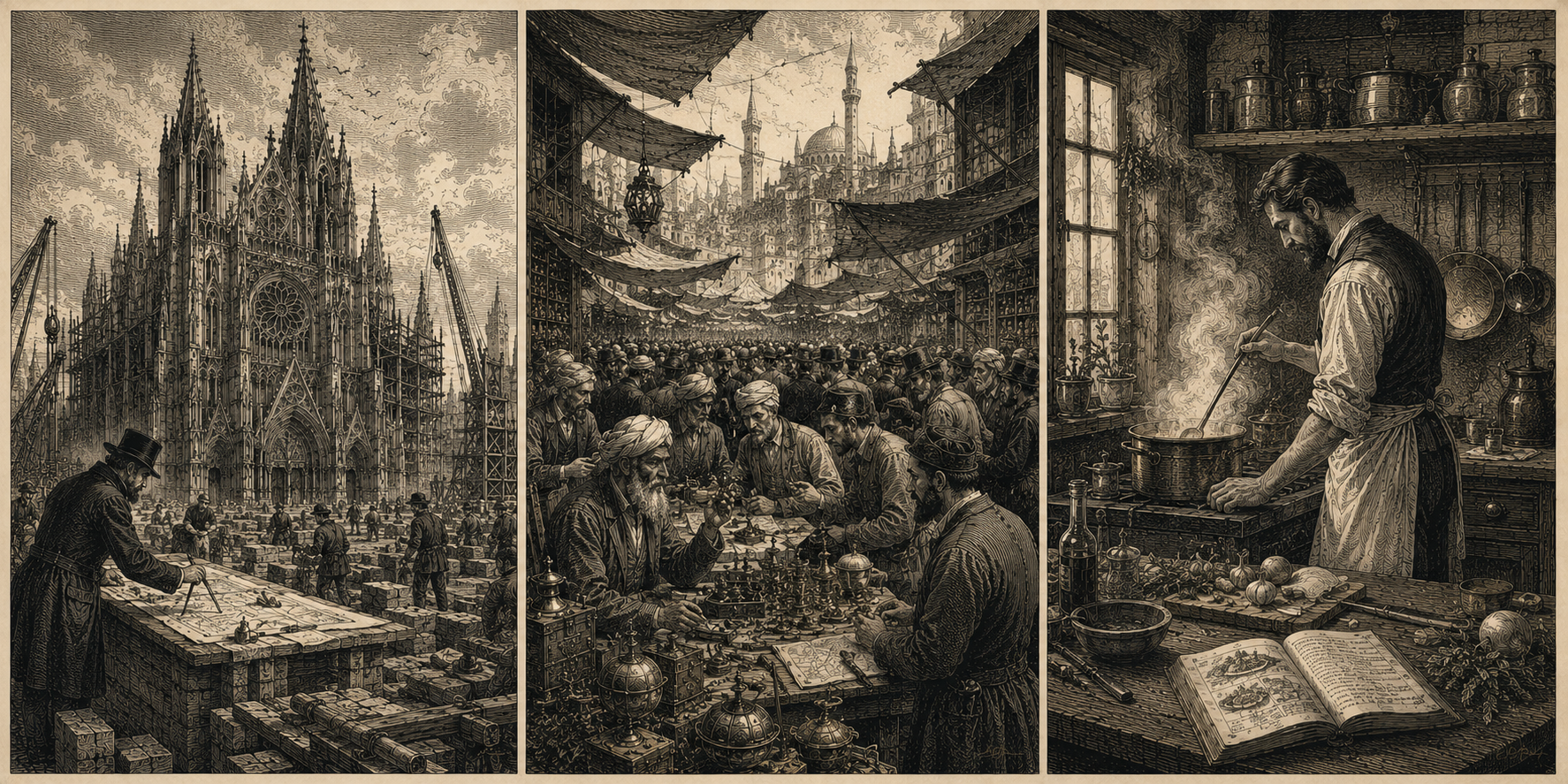
Eric Raymond’s “The Cathedral and the Bazaar”1 described two fundamentally different ways of building software. The Cathedral represented centralized, carefully planned development directed by a small group of maintainers. The Bazaar represented open collaboration: large communities, public iteration, distributed labor, and software evolving through many contributors.
For decades, the Bazaar became the dominant cultural myth of open source. Public repositories, pull requests, and community participation were not just practical tools, but moral ideals. Good software was expected to emerge from openness and collective effort.
AI-assisted software development is changing the economics and the ergonomics behind that model. Implementation becomes cheap, and coordination becomes expensive. A single developer equipped with modern tools can now produce systems that previously required teams.
At the same time, software is becoming increasingly personalized: tailored to one person’s workflow, infrastructure, preferences, and habits. Instead of building generalized tools for the widest possible audience, developers increasingly build software that fits their own environment perfectly. Others may still read the code, fork it, or borrow ideas from it, but local modification often becomes cheaper than upstream coordination.
The new model is a kitchen.
Every kitchen evolves around the habits of its cook. Tools sit where they are convenient. Ingredients are substituted freely. Recipes are modified on instinct. Two people may start from the same dish and end up with completely different results.
Unlike the Bazaar, a kitchen is deeply personal. Recipes are shared freely, but kitchens rarely converge into a universal standard. Visitors may admire another cook’s techniques, yet still return home and prepare the dish their own way. In the Kitchen model, open source becomes less like public infrastructure and more like published craft: software as personal utility, openly visible, endlessly adaptable, and increasingly authored by individuals rather than communities.
In the Bazaar model, openness was mainly a way to coordinate people. You opened the codebase to attract contributors, spread work across many developers, avoid duplicated effort, and slowly build shared infrastructure.
In the Kitchen model, openness serves a different purpose. It provides visibility, learnability, and independence. Value shifts from “others can help build this” to “others can understand, adapt, and reclaim this.”
Source code starts to resemble recipes more than public construction projects. Most people do not submit patches to a cookbook, yet recipes remain enormously valuable because they transfer techniques, preserve knowledge, and provide foundations others can adapt to their own tastes and environments. The code is open not necessarily so everyone can co-author it, but so anyone can study it, modify it, and make it their own.
This also changes the meaning of forks. In the Bazaar, forks were often viewed as failures of governance or coordination. In the Kitchen, forks become normal and healthy:
- “I adapted this for my setup”
- “I removed features I don’t need”
- “I rewrote this around my workflow”
Forking becomes analogous to modifying a recipe2 at home.
Software evolves through local adaptation rather than centralized consensus. A developer will remove features, rewrite workflows, or optimize entirely around their own infrastructure because doing so is now cheaper than negotiating a generalized solution acceptable to everyone.
This model still depends on public circulation of ideas. Even if code contributions decline, people still copy ideas from each other constantly through imitation, recombination, critique, and inspiration.
Much of programming history already worked this way:
- Unix customization culture where ingredients were expected to be mixed in different ways
- shell workflows and personal scripts
- dotfiles designed to show others how a system is configured but rarely adopted one-to-one
These are often highly personal systems shared publicly, not collaboratively engineered products.
Open source remains essential because it preserves agency: the ability to inspect, repair, continue, and reshape software independently of its original author. The result is a world where software is increasingly personal, but where ideas, techniques, and tools still circulate freely between individuals, much like recipes passed from kitchen to kitchen.
Update (15-May-2026): Other people have described the same or a similar mental model:
Drew Breunig calls it "the Winchester Mystery House":
The ideas crystallized in "The Cathedral and the Bazaar" helped kick off a quarter-century of open source innovation and dominance.
But just as the internet made communication cheap and birthed the Bazaar, AI is making code cheap and kicking off a new era filled with idiosyncratic, sprawling, cobbled-together software.
Meet the third model: the Winchester Mystery House.—The Cathedral, the Bazaar, and the Winchester Mystery House3
And Thomas H. Ptacek, calls it "the Emacsification of Software":
First, it's personal software. Most of it will be useful only to its creator, and then forgotten, just like the dozens of obsolete little elisp programs littering my .emacs. Personal software defines the ethos of Emacs, which was carefully designed over decades to nurture these kinds of tools. "Emacsification" clocks that everything now works this way, not just baroque text editors.
—The Emacsification of Software4
-
Eric S. Raymond, The Cathedral and the Bazaar (1997), https://en.wikipedia.org/wiki/The_Cathedral_and_the_Bazaar ↩
-
Side note: There is rarely a single canonical version of a dish. The same recipe evolves into countless variations shaped by region, available ingredients, habits, and personal taste. Instead of converging into one standard, we distinguish them by origin or authorship: à la provençale, à la milanaise, à la grandma, à la Jacques Pépin. The variation itself becomes part of the identity of the dish. GNU grep and BSD grep were different variations of the same tool, but these were more like publisher or distribution variations. The Kitchen model pushes personalization much further, toward software shaped directly around the habits and preferences of individual developers. ↩
-
The Cathedral, the Bazaar, and the Winchester Mystery House ↩